
Should you’ve launched music to streaming platforms via a distributor like CD Child, you in all probability know you receives a commission to your streams within the type of recording royalties. However do you know that those self same streams are producing extra royalties that you simply may be lacking? Many unbiased artists don’t take the straightforward steps wanted to say these royalties, leaving cash on the desk.
On this weblog, you’ll be taught the six foremost varieties of music royalties, how every of them works, and the way to acquire them to spice up your earnings.
What are music royalties?
Music royalties are funds owed to rights holders when their music is used or reproduced underneath license. Completely different makes use of generate several types of royalties — and since each track carries two separate copyrights (the recording and the composition), even a single use can generate a number of royalties without delay.
The 2 types of music copyright: recordings and compositions
The music trade’s royalty construction is constructed on music copyright — the authorized proper to repeat, distribute, carry out, and monetize a chunk of music.
There are two types of copyright inherent in each track. Makes use of of every copyright generate corresponding royalties.
- Recording: the actual recording of the track
- Composition: the underlying music and lyrics
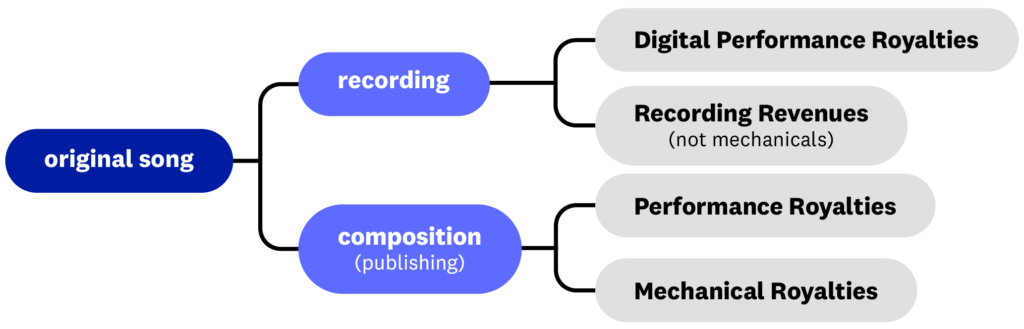
The chart under reveals how royalties move from the 2 types of music copyright. Makes use of of the sound recording can generate recording royalties and digital efficiency royalties — paid to artists, labels, and different house owners of the sound recording. Makes use of of the composition generate efficiency royalties and mechanical royalties — paid to songwriters, composers, lyricists, and/or publishers.
Should you’re an unbiased artist writing and recording your personal music, you in all probability personal each the recording and composition rights in your releases — entitling you to royalties generated from each. On this subsequent part, we’ll have a look at every kind of royalty that stems from the recording and composition of a track.
The six foremost varieties of music royalties
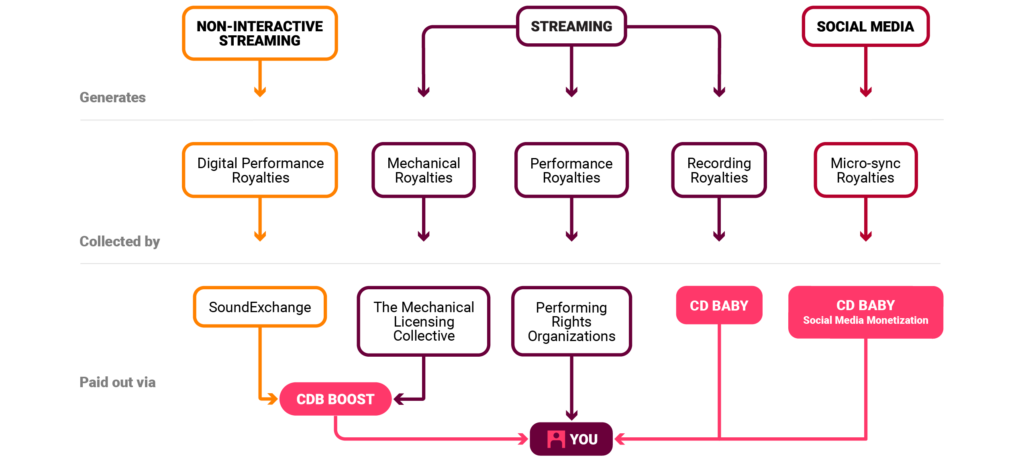
The chart under offers you a preview of solely the commonest royalties unbiased artists obtain after distributing their music to platforms like Spotify and Apple Music, social video platforms like TikTok and YouTube, and non-interactive streaming platforms like Pandora and SiriusXM.
As you’ll see, there are much more methods to generate royalties via stay performances, sync licensing offers, radio play, and extra. However we’ll begin with the fundamentals.
1. Recording Royalties
What they’re: Recording royalties come up from the use or digital replica of the sound recording of music. That features streams, digital downloads, bodily gross sales of your music, and extra.
Paid to: The proprietor of the sound recording — usually the recording artist and/or their label.
Should you distribute your music with CD Child, you keep full possession of your sound recordings and obtain 91% of your recording royalties from streaming exercise on platforms like Spotify and Apple Music. CD Child takes a 9% share, aligning our success with yours.
How one can acquire recording royalties: Your distributor routinely pays you recording royalties to your streaming exercise. Join a free CD Child account right this moment to distribute your music and begin incomes out of your streams.
2. Mechanical Royalties
What they’re: Mechanical royalties are generated at any time when a composition is reproduced, digitally or bodily. These royalties apply to interactive streams on platforms like Spotify and Apple Music, digital downloads, bodily gross sales, and extra.
Paid to: Songwriters, composers, lyricists, and/or publishers. Should you personal each a track’s recording and composition rights, then mechanicals are merely yet one more royalty kind you possibly can acquire out of your work. Should you personal a track’s composition and another person information and releases a canopy of it — on vinyl, streaming, wherever — you’re owed royalties for his or her use of it.
How one can acquire mechanical royalties: Should you’re a CD Child artist, you possibly can declare mechanical royalties in your music by including CDB Enhance to your releases. CDB Enhance registers your music with The Mechanical Licensing Collective (The MLC), which is the principle non-profit group within the U.S. for serving to songwriters acquire mechanical royalties.
3. Efficiency Royalties
What they’re: Efficiency royalties are earned when a composition is performed or carried out publicly. That may imply radio airplay, stay performances, background music in public areas, streaming on interactive platforms, and tv broadcasts.
Paid to: Songwriters, composers, lyricists, and/or publishers.
How one can acquire efficiency royalties: Should you’re based mostly in the USA, register your music with a performing rights group (PRO) like ASCAP, BMI, or SESAC to start out gathering efficiency royalties. For artists outdoors the U.S., your nation has its personal PRO.
|
4. Neighboring Rights Royalties
What they’re: Neighboring rights royalties compensate recording artists and sound recording house owners when a track is performed publicly. They’re referred to as “neighboring” rights as a result of they sit alongside efficiency royalties, however compensate rights holders for the usage of a sound recording as a substitute of the composition.
Right here’s the place it will get a bit messy. Strictly talking, neighboring rights don’t exist in the USA. U.S. legislation solely requires terrestrial radio stations (AM/FM) to pay efficiency royalties on makes use of of the composition — not the recording. The U.S. has a partial equal in Digital Efficiency Royalties to cowl spins on non-interactive streaming platforms like Pandora, SiriusXM, and iHeart Radio, however extra on that within the subsequent part.
Paid to: Performing artists and/or house owners of the grasp recordings (typically an unbiased artist or a label).
How one can acquire neighboring rights royalties: In case your music is getting worldwide play, register immediately with SoundExchange and choose into their international mandate to gather worldwide neighboring rights (together with terrestrial radio play outdoors the U.S.). SoundExchange can acquire these royalties for you thru reciprocal agreements with international Collective Administration Organizations (CMOs), however be aware that protection varies by territory.
5. Digital Efficiency Royalties
What they’re: Though the U.S. doesn’t have neighboring rights, digital efficiency royalties are a partial equal for rights holders. These royalties cowl makes use of of the sound recording on non-interactive streaming platforms like Pandora, SiriusXM, and iHeartRadio.
Outdoors the U.S., the place artists and rights holders do earn from conventional radio play, royalties from non-interactive stations are thought of simply one other royalty supply underneath the neighboring rights umbrella.
Paid to: featured recording artists, non-featured session musicians, and the house owners of the sound recording copyright
How one can acquire digital efficiency royalties: The U.S. authorities designated SoundExchange because the official sole entity accountable for gathering and distributing digital efficiency royalties to performing artists and house owners of the sound recording. Payouts from SoundExchange are divided by legislation: 50% goes to the sound recording copyright proprietor (an artist or report label), 45% to the featured artist, and 5% to a fund for non-featured session musicians.
Should you’re a CD Child artist, you possibly can declare your digital efficiency royalties by including CDB Enhance to your launch. CDB Enhance registers your music with SoundExchange’s home providers and helps you simply acquire digital efficiency royalties.
6. Sync (and micro-sync) Royalties
What they’re: Sync royalties are generated when your music is synchronized with visible media. That may entail particular person licensing offers for utilizing music in movies, tv, and video video games or blanket licensing agreements to be used of music on social video platforms like TikTok or Instagram.
Paid to: Sync royalties are cut up between songwriters and publishers (for the composition share) and artists/report labels (for the sound recording share).
How one can acquire sync royalties: You possibly can acquire micro-sync royalties utilizing CD Child’s Social Video Monetization service. Individually, you may make your music eligible for sync licensing offers by registering with CDB Enhance.
The music royalty guidelines for unbiased artists
Now that you simply perceive the core music royalty sorts, listed below are subsequent steps to gather them:
- Launch your music with CD Child and routinely obtain recording royalties from interactive streaming and downloads.
- Register with a PRO (ASCAP, BMI, SESAC, or your nation’s PRO) to gather efficiency royalties from radio, tv, reveals, and streaming.
- Add CDB Enhance to your launch to gather mechanical royalties from interactive streaming within the U.S. by way of The Mechanical Licensing Collective and digital efficiency royalties from non-interactive streaming by way of SoundExchange (neighboring rights royalties for artists outdoors the U.S).
- Decide into CD Child’s Social Video Monetization service to gather micro-sync royalties from user-generated content material on YouTube, TikTok, Fb, and Instagram.


